

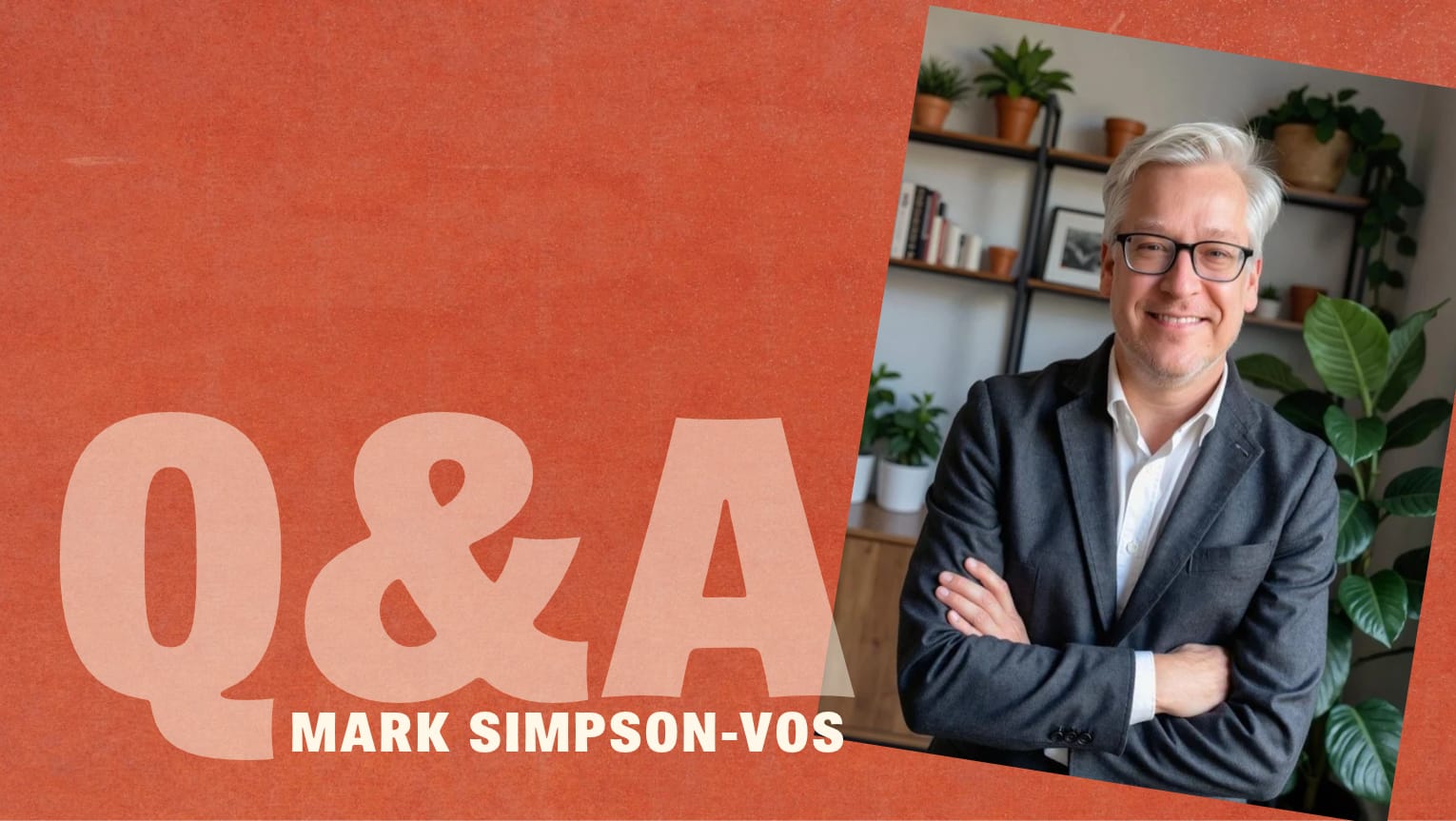
A few weeks ago, I chatted with Mark Simpson-Vos, an old friend of mine who spent nearly 30 years in editorial roles at the University of North Carolina Press, including 13 years as editorial director. While he was there, Mark developed and acquired scholarly and general interest books in a wide range of fields including history, American studies, religious studies, anthropology, environmental studies, literary studies, and Native American and Indigenous studies. He has also taught writing to college students and professionals in a variety of settings. And he has just founded I'll Write Already Consulting, which provides developmental editing, coaching, workshops, and strategic content consulting to individuals and organizations.
Given the unsettled nature of the publishing industry these days, I wanted to talk with Mark about his experiences, and his advice for writers and editors. Enjoy!
This interview has been edited for length and clarity. Links to bookshop.org are affiliate links.
Megan Kate Nelson: How did you get your start in publishing?
Mark Simpson-Vos: When I look back now, I can see that I was preparing for a publishing career quite early. When I was an undergraduate, I took lots of writing classes. I didn't ever take formal how-to-be-an-editor classes— those things do exist, but I never took one. I did take practically every writing class I could at my undergrad institution, though, while still graduating with a political science major.
MKN: Oh, you were political science, not English!
MSV: I was English as well. I added an English major very late. I also worked, as an undergraduate, at the writing center as a tutor. I did the same thing as a graduate student. I taught writing as a graduate fellow, and so I was steeped in that world of helping writers write. But it really wasn't until I began working as an editorial assistant on an academic journal, Early American Literature, that I had my first real job in publishing. My dissertation advisor at UNC Chapel Hill, Philip Gura, was the editor at the time, and I had an opportunity to become his editorial assistant. It was my first exposure to the peer review process. It was my first exposure to how to say no politely when you're declining to publish something. Turns out to be a very useful skill. And it exposed me to what a very high level of peer review and decision making looks like in a top academic journal. I loved it. And that coincided with the crisis that every graduate student goes through, you know: Do I actually want to finish this dissertation? What do I really want to be when I grow up?
It was around that time that I also worked at UNC Press as an intern. I photocopied manuscripts five hours a week and sent decline letters to folks that we were not going to publish, and I answered phones for five hours a week in the afternoons. And I loved it. I loved everything about it. I love to read, and I love to learn things, and I was exposed to all of these new ideas and all these great, interesting new books, some of them by people that I had idolized as a student and graduate student. So, when a full time job opened in July 1998, I applied, and I got it. And I told my dissertation advisor, I'd really like to try this. I think I'd like to take a six month leave of absence to determine whether I really want to go into publishing or if I want to finish my PhD. And he was extremely supportive, which I'm grateful for to this day. But it only took me six weeks to know that I really, really wanted to work in publishing. And I was at UNC Press from July 1998 until June 30, 2025.
MKN: We first met in a book exhibit at a conference. It can be nerve-wracking to go up to an editor, especially someone of your caliber and experience. What mistakes have you seen when historians make that first approach and that first pitch of their project?


